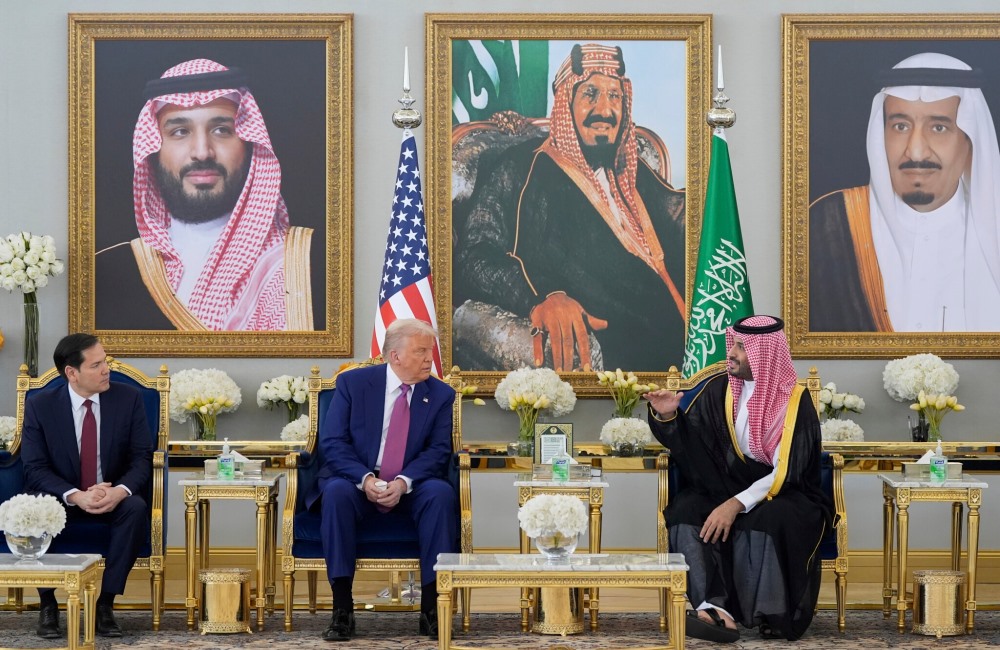
President Donald J. Trump, speaking from Saudi Arabia during his tour to Riyadh from May 13 to 16, announced a $600-billion commitment from the Kingdom to invest in the United States. This historic initiative marks a new era of strategic cooperation between two nations whose partnership has spanned more than eight decades.
The sweeping package includes major investments across energy, defense, technology, healthcare and infrastructure. From the outset, it reflects a joint vision of long-term prosperity and security, built on mutual trust and bold ambition.
One of the standout announcements involves Saudi Arabia’s DataVolt, which will invest $20 billion in AI data centers and energy infrastructure in the United States. This move lays a foundation for greater digital connectivity and sustainable growth.
At the same time, leading American companies such as Google, Oracle, Salesforce, AMD and Uber are collaborating with Saudi partners to invest $80 billion in transformative technologies in both countries. This fusion of resources and innovation positions both nations at the forefront of the global tech revolution.
Infrastructure projects are another central pillar of this alliance. American engineering giants—Hill International, Jacobs, Parsons and AECOM—will lead developments like King Salman International Airport, King Salman Park, The Vault and Qiddiya City. These initiatives bring $2 billion in services exports back to the U.S., highlighting the global reach of American design and construction.
Key exports also include $14.2 billion worth of GE Vernova gas turbines and energy solutions and a $4.8 billion order of Boeing 737-8 passenger aircraft for Saudi aviation company AviLease. These deals not only strengthen economic ties but also support thousands of American manufacturing jobs.
In healthcare, Saudi investment firm Shamekh IV Solutions, LLC is launching a $5.8 billion project that includes a new high-capacity IV fluid facility in Michigan. This underscores the importance of health security and the rising role of Saudi capital in advancing U.S. medical infrastructure.
Beyond individual projects, new sector-specific funds—such as the $5 billion Energy Investment Fund, the $5 billion New Era Aerospace and Defense Technology Fund and the $4 billion Enfield Sports Global Sports Fund—are being launched to channel Saudi capital into U.S. industries. These funds aim to drive innovation, create jobs and ensure long-term competitiveness.
On the defense front, the two countries signed a nearly $142 billion agreement—the largest defense sales package in U.S. history. This monumental deal includes air and missile defense systems, maritime security assets, space and communication technologies and modernization of Saudi Arabia’s armed forces.
In addition to the hardware, the agreement provides for training programs that will enhance the capabilities of Saudi military academies and medical services. These efforts strengthen regional security and deepen interoperability between the two nations’ armed forces.
This package comes together as the latest chapter in a long relationship, dating back to the 1945 meeting between King Abdulaziz Al Saud and President Franklin D. Roosevelt aboard the USS Quincy. Since then, the partnership has grown more sophisticated, with today’s economic agreements eclipsing all past benchmarks.
In 2023, Saudi direct investment in the United States reached $9.5 billion, with a focus on transportation, real estate and automotive sectors. In 2024, bilateral goods trade totaled $25.9 billion, including a trade surplus of $443 million in favor of the United States.
Energy cooperation has also deepened. The U.S. Department of Energy and Saudi Arabia’s Ministry of Energy signed an agreement to collaborate on infrastructure development, innovation and financing. A separate memorandum between their industrial ministries enhances cooperation in mining and critical minerals—key to building resilient global supply chains.
The partnership now stretches into space as well. NASA and the Saudi Space Agency have agreed to include a Saudi CubeSat on the upcoming Artemis II mission. This satellite will study space weather and be deployed into high Earth orbit after launch, symbolizing a shared pursuit of scientific discovery.
Trade modernization is also underway. The updated Air Transport Agreement allows U.S. airlines to carry cargo between Saudi Arabia and third countries without stopping in the U.S.—a major advantage for logistics companies. Saudi carriers now have reciprocal rights, strengthening commercial aviation networks.
Cultural and scientific exchanges are flourishing. The Smithsonian Institution and the Royal Commission for AlUla have signed agreements to support conservation, research and exhibitions—including a project focused on ancient Dadan artifacts and a dedicated Arabian leopard conservation exhibit in Washington, D.C.
Saudi Arabia remains the largest partner in U.S. Foreign Military Sales, with active cases valued at over $129 billion. Today’s new agreements further expand U.S. defense industry involvement and create long-term sustainment opportunities with Saudi partners.
Under President Trump’s leadership, this moment stands as a clear milestone in his America First Trade and Investment Policy. It showcases how strategic international agreements can advance national priorities while reinforcing America’s economic dominance.
Coming on the heels of a U.S.-UK trade deal, the $600-billion Saudi investment cements President Trump’s reputation as a dealmaker delivering results on a global stage. It builds upon the momentum of 2017’s agreements and sets the course for a renewed era of American prosperity, innovation and global leadership.
What began eight decades ago as a diplomatic encounter now stands as one of the world’s most consequential economic and strategic alliances—built to last and ready for the future.

 Washington Politics
Leave a comment