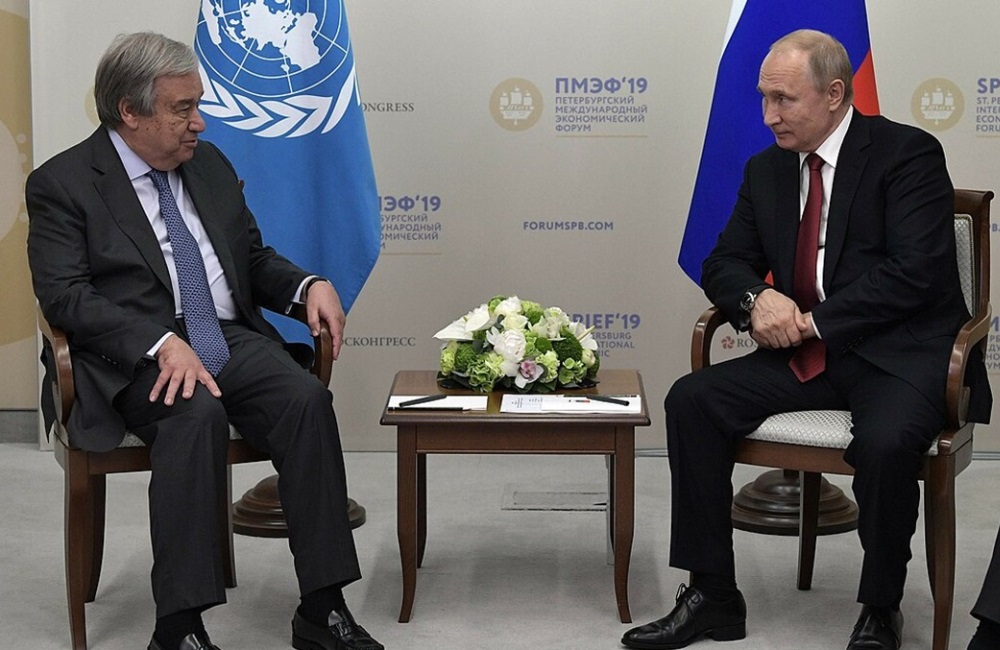
The attendance of UN Secretary-General António Guterres at the 2024 BRICS summit in Kazan, Russia, has sparked a firestorm of global debate, laying bare the growing fractures within international diplomacy. In his article for Australian Outlook, a publication of the Australian Institute of International Affairs (AIIA), independent journalist Daniel Raynolds expertly captures the intensifying moral and strategic dilemma confronting world leaders and international institutions alike. At the heart of the debate is a troubling question: can dialogue coexist with accountability?
Guterres’s appearance alongside Russian President Vladimir Putin—a figure widely condemned for his role in the war in Ukraine and wanted by the International Criminal Court—triggered a wave of criticism, not just from political analysts, but also from Ukrainian journalists, Baltic leaders and international observers who see this engagement as a blow to the UN’s moral authority.
Moral Standing: One Argument
Raynolds mentions in his article the criticisms made by Rutgers University professor Alexander J. Motyl, who argued forcefully that Guterres’s participation at the summit, particularly his perceived cordiality toward Putin, amounts to legitimizing authoritarian aggression. Writing in The Hill, Motyl asserts that meeting a “war criminal” in a setting of mutual respect is not diplomacy—it is complicity.
Ukrainian journalist Ihor Petrenko echoes this frustration, highlighting the stark contrast between Guterres’s absence from the Ukraine peace summit in Switzerland and his acceptance of Putin’s invitation. Petrenko frames the Secretary-General’s actions as hollow gestures devoid of real commitment to justice, pointing to Putin’s trivialization of the war as a mere “family quarrel”—a comment Guterres did not challenge—as an example of the UN’s failure to take a principled stand.
Lithuania’s leadership took an even bolder stance. Prime Minister Ingrida Šimonytė and Foreign Minister Gabrielius Landsbergis publicly condemned Guterres’s actions, calling into question his integrity and ability to function as an impartial mediator. Their demand for accountability—even suggesting that he step down—illustrates a growing impatience with what is perceived as moral inconsistency from the UN’s highest office.
Necessity of Dialogue: The Other Argument
Yet the backlash is not universal. Voices like risk analyst and columnist Bahauddin Foizee offer a more measured interpretation of Guterres’s conduct. In Raynolds’s article, Foizee argues that Guterres’s attendance at the BRICS summit represents not an endorsement of Putin, but a strategic necessity. From this perspective, excluding actors like Russia from international dialogue risks pushing them further into isolation and intransigence, making peace more difficult to achieve.
Writing in the Oped Column Syndication, Foizee defends the Secretary-General’s balancing act, suggesting that abstaining from the Switzerland peace summit was a calculated move to preserve the UN’s role as a neutral intermediary. Attending would have signaled alignment with Western perspectives and potentially alienated other key stakeholders in the conflict, undermining future negotiation efforts.
His view is underpinned by a fundamental principle of international diplomacy: sometimes, peacebuilding demands engagement with even the most controversial figures. While uncomfortable, such engagement may be vital to keeping open the narrow channels through which resolution might be reached.
Crisis of Credibility
Raynolds’s article reflects the mounting tension between these two schools of thought—one rooted in moral absolutism, the other in diplomatic pragmatism. This tension is not new, but it has taken on new urgency as the war in Ukraine grinds on and authoritarian regimes appear increasingly emboldened.
The sharp divide raises profound questions about the role of international organizations like the United Nations. Should the UN act as a moral compass, standing firmly against injustice wherever it occurs? Or should it prioritize dialogue, even when it requires sitting across from leaders accused of war crimes?
In today’s fractured world order, where global institutions are often seen as either ineffective or politically compromised, Guterres’s actions in Kazan may have long-lasting implications. For critics, his presence at the BRICS summit represents a betrayal of the UN’s founding principles. For supporters, it is a testament to the difficult, often thankless work of keeping diplomacy alive in an age of geopolitical division.
Leadership Under Fire
What is clear is that Guterres’s leadership is now under intense scrutiny. As Raynolds emphasizes, this episode is not just about one summit or one leader. It reflects a deeper crisis of legitimacy within the global order—one in which moral clarity and pragmatic engagement increasingly appear to be at odds.
In the end, the question may not be whether Guterres made the right choice, but whether the current international framework is capable of managing the tensions of our time. If the UN hopes to remain relevant in a world of rising authoritarianism, deepening conflicts and faltering faith in multilateralism, it must grapple seriously with this central dilemma: can peace ever be brokered without justice?
As the war in Ukraine drags on and global trust in diplomacy continues to erode, António Guterres’s legacy—and that of the United Nations—may well be defined by how they choose to navigate this perilous moral and strategic crossroads.
 Washington Politics
Leave a comment